
Play Free Dots and Boxes Online
How to Play Dots and Boxes
Default board is 5×5 boxes (6×6 dots). Blue moves first. Take turns claiming an empty edge; close a box to score it and move again. Most boxes wins; equal counts are a draw. Pick an AI level and a colour, then start.
What Dots and Boxes Is
Dots and Boxes is a pencil-and-paper classic: players draw edges on a grid of dots, and whoever claims more boxes wins. Each turn is simply choosing one unused edge—not moving pieces around the board.
What decides a game is tempo: when to leave a third side for the opponent, and when to take a long chain yourself. Closing a box grants an extra turn, so chain captures are common once the board fills.
It looks like connecting dots on paper. In practice it is about parity and control—avoid giving away the third side, and decide who opens the long chains. The rules page covers the fine print; if you want the feel of the game, start with the AI board above.
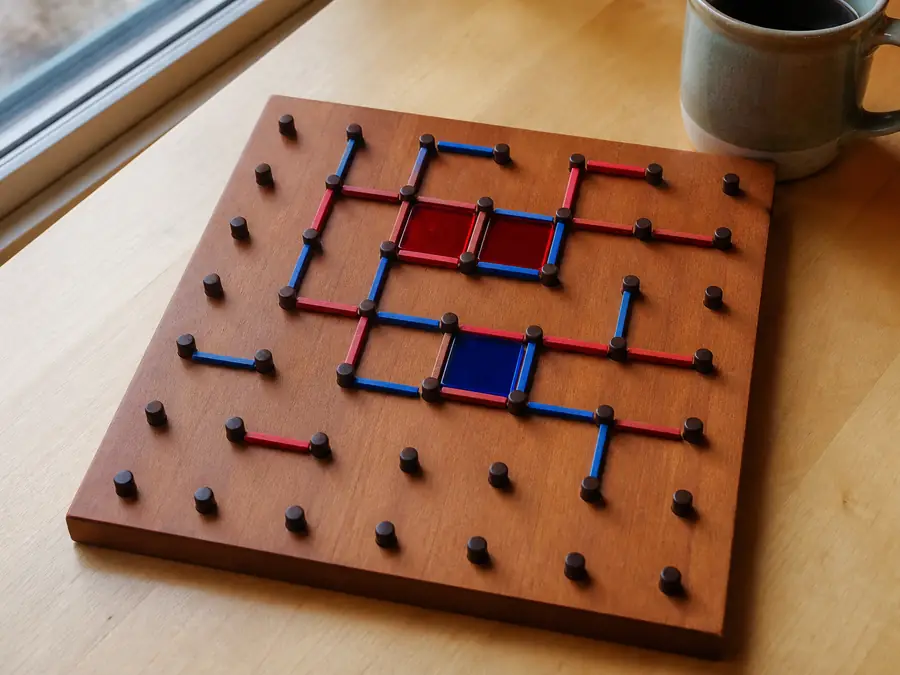
Dots, Edges, and Boxes
The board is a 6×6 array of dots that forms 5×5 boxes. Tap any unused edge between two dots. Blue opens; when you close a box it is yours, and you immediately draw another edge.
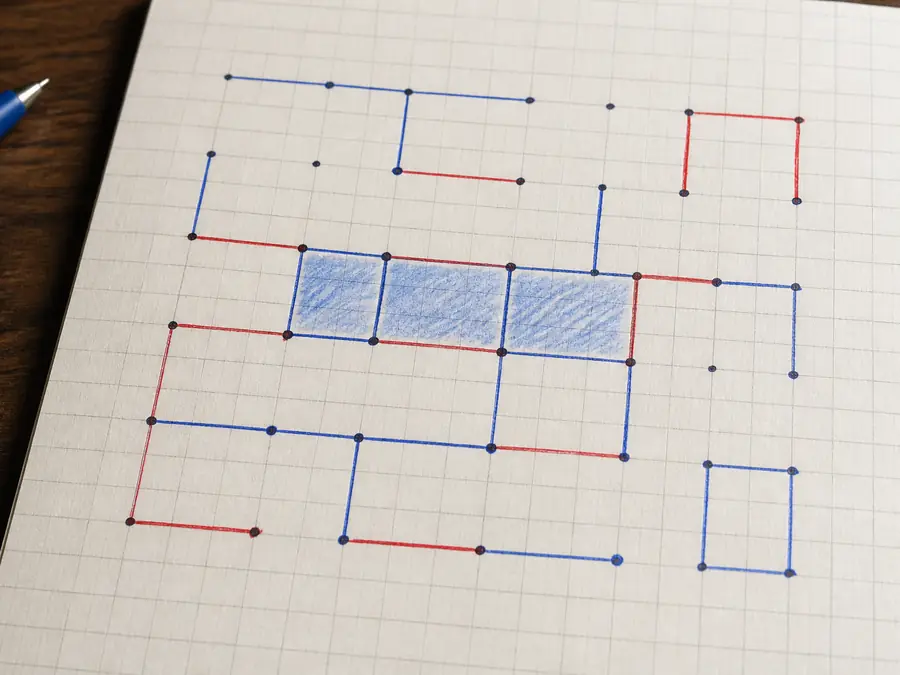
Claim a Box, Move Again
Fill all four sides of a square and that box is yours—plus another turn. Linked boxes often fall in a chain, but if you hand the opponent a third side too early, they may take the whole run.
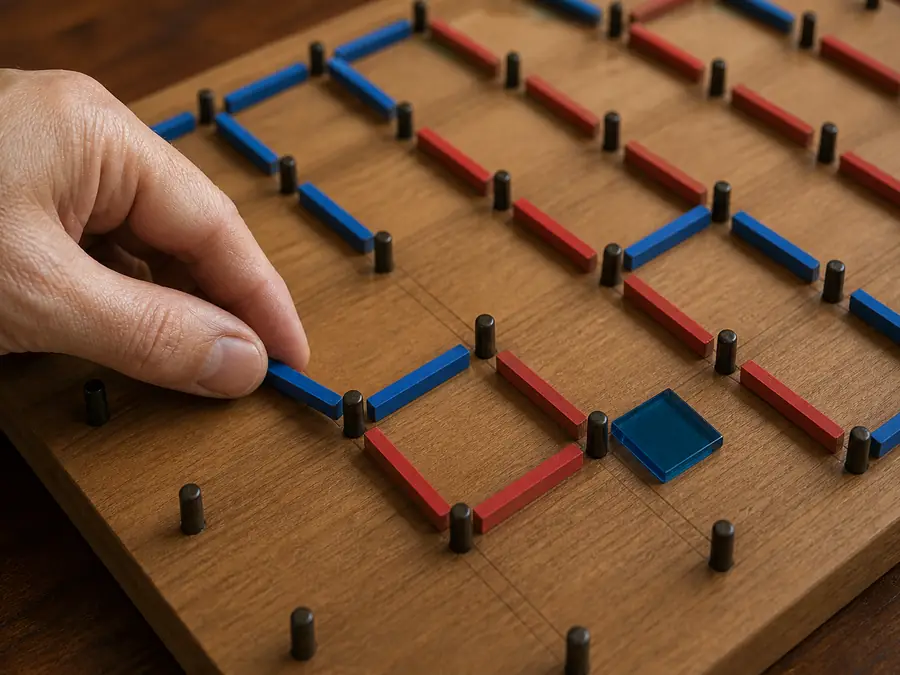
Hints Follow Your AI Level
Choose from multiple AI levels, then play as Blue to open or Red to reply. Hints use the same level, and undo rewinds both your edge and the AI response. After the game, replay the turn when a third side was gifted or a long chain was missed. All AI calculation stays in your browser.
5×5boxes by default
Extraturn after a claim
Blue / RedBlue moves first
Drawswhen box counts tie
Common questions
How does this board decide the winner, and what if the box counts match?
When every edge has been drawn, the side with more boxes wins. Equal counts are a draw. The default board is 5×5, so there are 25 boxes, and games often finish with a one-box margin. In an online room you can resign before the board is full, or ask the other player to agree to a draw.
Does the AI calculate on this device?
Yes. Color choice, hints, and the opponent's replies all run in the browser you already have open. There is no separate program to install, and the next edge does not wait on a remote server. Change the strength in the sidebar whenever you like: Gentle practice while you learn the rules, then a sharper level for a serious game. The hint uses whichever level is selected.
Why did the other player take a whole string of boxes right after I claimed one?
Closing a box gives you another turn. If that extra edge finishes two boxes at once, both are yours, and you still have to move again. Open a long chain with that turn, and the other player can walk down it and take the boxes that follow. Before you take a box that is sitting there, see whose turn it will be afterward. The more common loss in the middle of the game is drawing the third side of a box too early and handing that box over.
Do I have to start on the outer ring?
No. The first edge can sit on the border, in a corner, or toward the middle, as long as it is still empty. On a 5×5 board, the early moves matter more for keeping every box short of three sides than for claiming one fixed spot.
How should I use hints, undo, and replay without just copying the line?
Look at the edge yourself first. Ask whether it gives away a third side, and whether it forces the other player to open a chain. Then open the hint and compare. The hint follows the AI level you have selected. Against the AI, undo takes back your last edge together with the reply just played, so you can return to that fork and try again. With two players on one device, undo steps back only one edge. Replay is for finding the move where the boxes started falling in a chain.
Can I play without an account or an app?
Yes. Open the page on a phone or computer and draw an edge. There is no account, email, or password. Adding the site to your home screen is optional, and a full game works without installing anything.
Can I choose Blue or Red?
Against the AI, yes. As Blue you draw the first edge. As Red the AI opens. Switching color mid-game starts a new game, and the edges already drawn do not stay. In an online room you pick your color when you create it, and the first person who joins takes the other side. Two players on one device do not choose colors: Blue moves first, and you take turns.
If I close the page, is this game still there? Does changing the AI level start over?
Games against the AI, and games on one shared device, are saved separately in this browser. Close the page and open it again, and you can usually continue the game you left. Changing the level mid-game does not start over. Later replies and hints use the new level. Clearing this site's data usually removes those unfinished games. An online game stays in the room. If the connection drops, opening the link again usually puts you back in the same seat.
If I invite a friend online, can I undo and use hints the way I can here?
No. Once an online room accepts an edge, that edge is sent to the other player. There is no hint and no undo. The board stays 5×5. If the connection drops, opening the page again usually brings you back to the same room. After both players leave, the room usually stays for about 20 minutes. When the host closes the room, the old link stops working.
How is two players on one device different from playing the AI?
Two people share one device and take turns face to face. You do not need a network connection, and neither side gets a hint. Blue moves first. Draw an edge, then pass the device across. If a move was rushed, undo steps back one edge, and replay is still there so you can stop and talk about whether that edge gave away a third side. To swap who opens, start another game and let the other person play Blue.
